English
 中文简体
中文简体

 2026-07-24
 Industry News
Content
A painting workshop's pre-treatment equipment typically includes degreasing tanks or spray stations, rinsing sections, phosphating or conversion coating tanks, passivation stages, and a drying oven, all arranged in a sequential line that prepares metal surfaces before paint or powder coating is applied. This equipment removes oils, oxides, and contaminants from the metal surface while building a chemical conversion layer that significantly improves paint adhesion and corrosion resistance. A complete system such as Pre-treatment Equipment integrates these stages into a coordinated line so that parts move through each chemical process at controlled time and temperature before reaching the coating booth.
The sections below break down each stage of a typical pre-treatment line, the equipment used at each step, and why proper surface preparation has such a large impact on final coating quality.
The first stage in almost every pre-treatment line focuses on removing oils, grease, and machining residues left over from manufacturing processes before the part reaches any chemical conversion step.
Immersion tanks fully submerge parts in a heated alkaline or acidic degreasing solution, typically maintained in the range of 50 to 70 degrees Celsius for alkaline cleaners, allowing the solution to dissolve and lift oils from complex part geometries that spray systems might not fully reach.
Spray degreasing uses pressurized nozzles to apply cleaning solution directly onto the part surface, which is often faster than immersion for flat or simple geometries and is commonly used in continuous conveyorized pre-treatment lines where throughput speed matters.
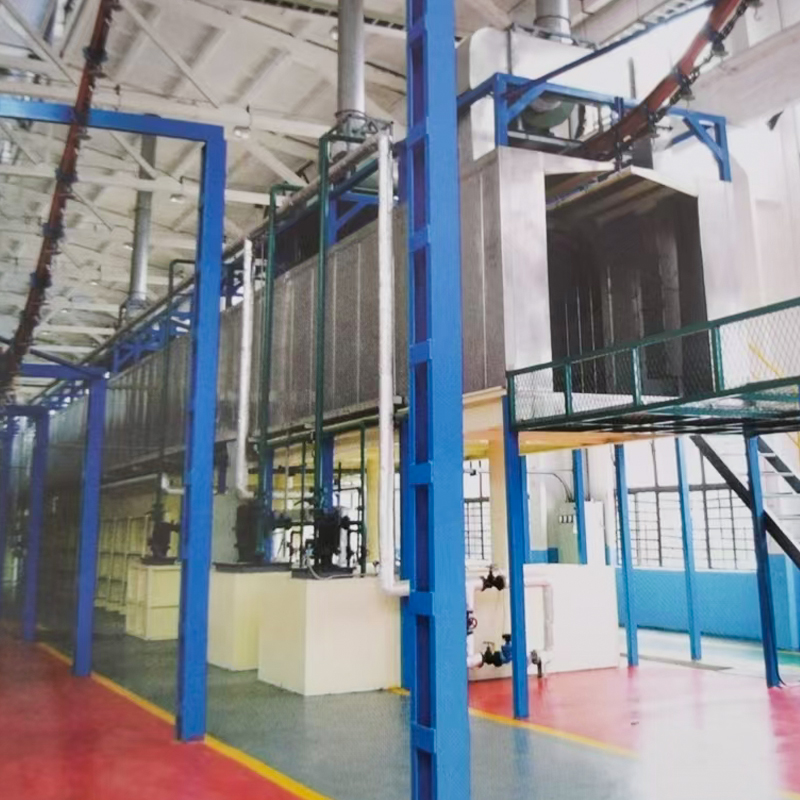
Rinsing equipment sits between nearly every chemical stage in the pre-treatment line, and its role is often underestimated despite being critical to final coating performance.
Standard water rinse tanks remove residual chemical solution from the part surface before it enters the next processing stage, preventing cross contamination between different chemical baths that could otherwise weaken the conversion coating or degrease effectiveness.
A final rinse using deionized or reverse osmosis treated water is commonly used before drying, since tap water mineral content left on the surface can interfere with paint adhesion. Industry coating guidance frequently notes that inadequate final rinsing is one of the more common causes of premature paint failure in field conditions.
This stage is often considered the most critical part of the pre-treatment process, since it chemically transforms the bare metal surface to improve both paint adhesion and corrosion resistance.
Zinc phosphate treatment forms a crystalline conversion layer on steel surfaces, commonly used in automotive and industrial coating applications where corrosion resistance is a priority. This process typically operates at controlled temperatures around 40 to 60 degrees Celsius with carefully monitored bath concentration to achieve consistent coating weight across parts.
Iron phosphate treatment produces a thinner conversion coating than zinc phosphate and is often used for general industrial applications where cost efficiency is prioritized over maximum corrosion resistance, such as indoor equipment or lower exposure environments.
Newer nanoceramic pre-treatment technologies have gained adoption in some facilities as an alternative to traditional phosphating, offering reduced chemical sludge generation and lower energy consumption, according to general surface finishing industry sources discussing emerging pre-treatment chemistries.
After the conversion coating stage, a passivation or sealing rinse is often applied to further enhance corrosion resistance before drying.
This stage adds a measurable improvement in corrosion resistance performance, which is particularly important for parts that will face outdoor exposure or humid operating environments after coating.
Before parts can move into the paint or powder coating booth, all moisture from the rinsing stages must be fully removed to prevent coating defects.
| Oven Type | Typical Application |
| Convection drying oven | General moisture removal for most part types |
| Infrared drying oven | Faster surface drying for thin sheet metal parts |
| Combination IR and convection oven | Balances fast surface drying with even internal heating |
Drying oven temperature is typically set based on the substrate material and part thickness, since insufficient drying can trap moisture that later causes coating blistering, while excessive temperature on thin parts can cause warping.
Beyond individual tanks and stations, how the equipment is arranged and automated significantly affects both throughput and coating consistency.
Facilities scaling up production volume typically move from manual immersion tanks toward integrated systems like the Pre-treatment Equipment line, which combines these stages with automated control to maintain consistent surface preparation quality across high volume runs.
Pre-treatment equipment in a painting workshop covers several coordinated stages, including degreasing, rinsing, phosphating or conversion coating, passivation, and drying, each contributing to a clean, chemically prepared surface before paint or powder coating is applied. Skipping or poorly maintaining any single stage tends to reduce paint adhesion and corrosion resistance regardless of how good the final coating application itself is, which is why a properly designed and maintained pre-treatment line remains one of the most important investments in overall coating quality.
2026-07-24
Industry News
2026-07-17
Industry News
2026-07-10
Industry News
2026-07-03
Industry News
2026-06-26
Industry News
2026-06-19
Industry News
For exclusive deals and latest offers, sign up by entering your email address below