English
 中文简体
中文简体

 2026-07-17
 Industry News
Content
Conveying Equipment refers to the mechanical systems used to transport workpieces through successive stages of a production line, such as pretreatment, coating application, curing, and cooling, without requiring manual handling at each stage. In a coating line specifically, conveying equipment moves parts through spray booths, ovens, and drying tunnels at a controlled speed, ensuring uniform coating thickness and consistent processing time at every station. A properly designed conveyor system can increase line throughput by 30 percent or more compared to manual part transfer, since it eliminates the delays and inconsistency introduced by human handling between stages.
Beyond speed, conveying equipment also plays a direct role in coating quality. Parts that move at an inconsistent pace through a spray or curing zone often end up with uneven coating thickness or incomplete curing, so the conveyor's speed control and load stability are treated as critical engineering factors rather than a simple transport afterthought.
Within a coating production environment, conveying equipment does more than just move parts from point A to point B. It coordinates timing across the entire line so that each stage receives parts at the correct interval.
Each of these functions depends on precise speed synchronization, since a coating line typically operates as a continuous process where a delay or speed mismatch at one stage affects every station further down the line.
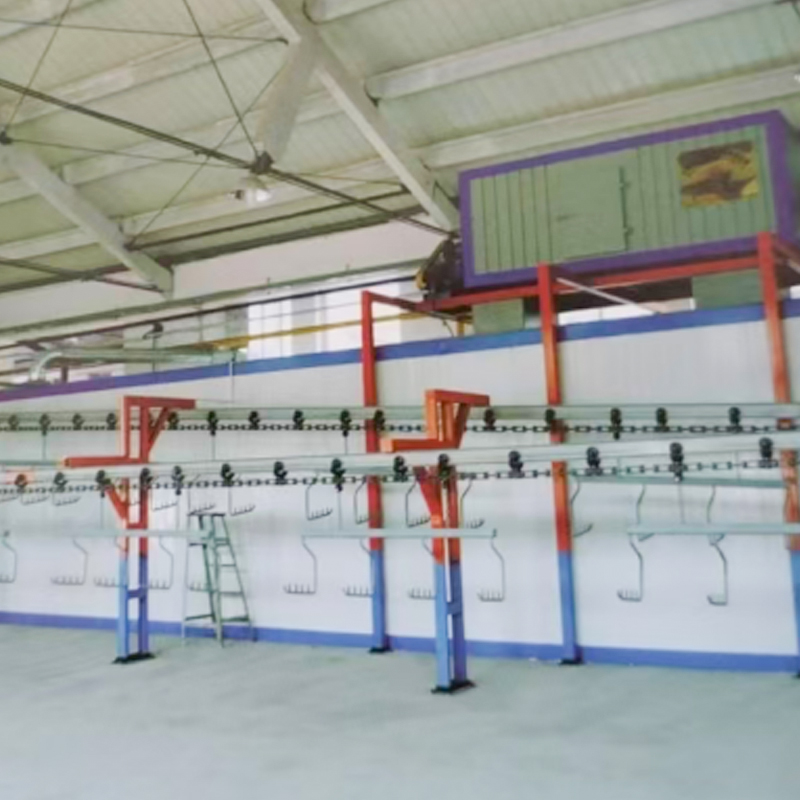
Different coating applications call for different types of conveying systems, largely based on part size, weight, and the specific process stages involved.
| Overhead chain conveyor | Suspends parts on hooks or fixtures, common for spray coating lines |
| Powder and free conveyor systems | Allows sections of the line to run at different speeds independently |
| Roller conveyor | Suited for flat or palletized parts moving through drying tunnels |
| Belt conveyor | Used for smaller, lightweight components in continuous coating processes |
Overhead chain conveyors are especially common in industrial coating lines because they keep parts elevated and rotating freely, which allows spray equipment to coat all surfaces evenly without the part resting on a fixed surface that could block coverage.
The reliability of a conveying system depends on several core components working together consistently over long operating hours in a production environment that often includes heat, moisture, and chemical exposure.
Chains used in oven sections must be rated for the curing temperature involved, since standard chain lubricants and materials can degrade quickly under sustained heat exposure, leading to premature wear and unplanned downtime.
Line speed is one of the most important variables a conveying system controls, since both spray application and curing time are directly tied to how long a part spends in each zone. Moving too quickly through a spray booth results in thin, uneven coating, while moving too slowly can cause excess buildup or drips.
Variable frequency drive motors allow line speed adjustments in small increments, which lets operators fine-tune dwell time in each zone based on the specific coating material and part size being processed. This level of control is one of the main reasons modern coating lines rely on motorized conveyors rather than fixed-speed or manual transport methods.
The physical layout of conveying equipment affects both production efficiency and floor space utilization. Common layout configurations include straight-line conveyors for simple processes and looped or serpentine layouts that maximize dwell time within a limited factory footprint.
Choosing the right layout depends on available factory space, the specific curing or drying time required by the coating material, and the overall throughput target for the production line.
Conveying equipment in a coating environment faces continuous exposure to overspray, heat cycling, and mechanical wear, making a regular maintenance schedule essential for consistent operation.
Facilities that follow a consistent maintenance schedule for their conveying systems generally experience fewer unplanned line stoppages, since worn components are identified and replaced before they cause a failure during active production.
Selecting the correct conveying system depends on part size, weight, coating process requirements, and available factory space. A system that is undersized for the part load will experience premature wear, while an oversized system adds unnecessary cost and complexity.
Coating equipment providers such as JY design their Conveying Equipment systems to match specific line throughput and part handling requirements, integrating drive control, load fixtures, and layout configuration into a coordinated system built for the demands of continuous industrial coating operations.
2026-07-17
Industry News
2026-07-10
Industry News
2026-07-03
Industry News
2026-06-26
Industry News
2026-06-19
Industry News
2026-06-12
Industry News
For exclusive deals and latest offers, sign up by entering your email address below