English
 中文简体
中文简体

 2026-06-12
 Industry News
Content
Pre-treatment equipment refers to the industrial machinery and process systems used to clean, condition, and chemically prepare metal or other substrate surfaces before the application of paint, powder coating, electroplating, or other surface finishing treatments. It is the first and most foundational stage of any industrial coating line. Without proper pre-treatment, coatings fail prematurely — they peel, blister, corrode underneath, or simply do not adhere with sufficient mechanical bond strength.
Pre-treatment equipment typically encompasses a sequence of process tanks, spray tunnels, rinse stages, and drying systems that remove contaminants such as oils, rust, mill scale, and oxides from the workpiece surface, and then apply a conversion coating — such as iron phosphate, zinc phosphate, or zirconium — that creates a chemically reactive interface between the base metal and the subsequent coating layer.
In industrial coating production lines, pre-treatment is directly responsible for 70–80% of a coating's long-term corrosion resistance performance. It is not optional — it is the quality foundation on which all subsequent finishing processes depend.
Metal surfaces as they arrive from fabrication are never coating-ready. Even freshly stamped or machined parts carry a film of rolling oils, cutting fluids, stamping lubricants, rust-preventive compounds, and atmospheric oxidation products. Welded assemblies additionally carry heat-affected zone oxides, weld spatter, and flux residues. All of these contaminants prevent intimate contact between the coating and the metal surface — creating weak adhesion points that become sites of coating failure over time.
Field failure analysis of coated metal products consistently identifies inadequate pre-treatment as the primary root cause of premature coating failure. Studies by coating industry technical bodies have found that over 80% of coating failures in the field originate at the substrate preparation stage, not from defects in the paint or powder coating material itself. This underlines why industrial manufacturers invest in properly engineered pre-treatment lines rather than treating surface preparation as a simple wash step.
Beyond corrosion protection, pre-treatment also improves:
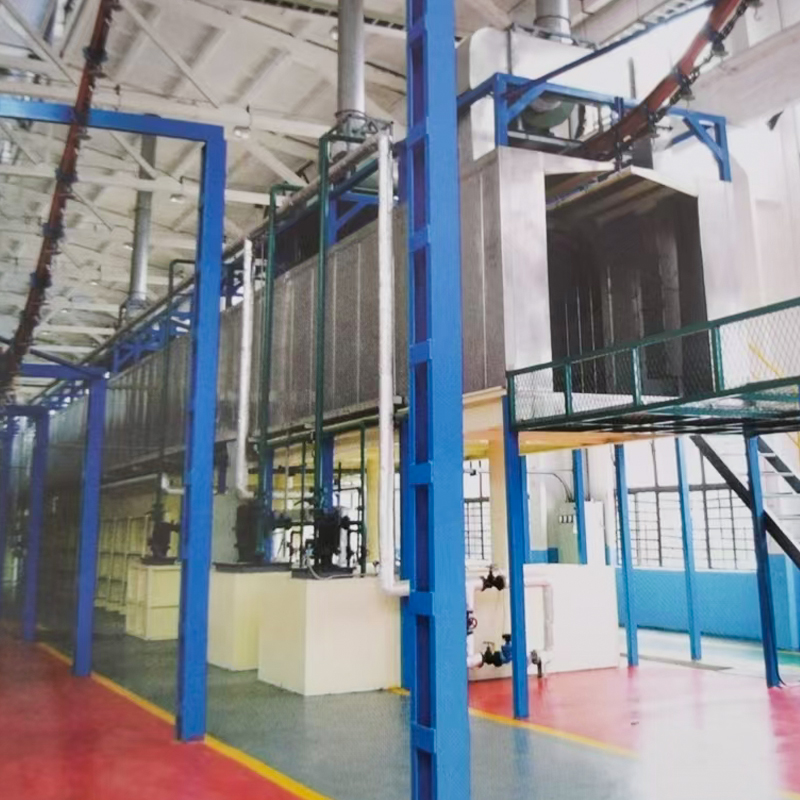
A complete industrial pre-treatment system is a multi-stage sequence, with each stage performing a specific preparation function. The number and configuration of stages varies depending on the substrate material, contamination level, coating specification, and production throughput requirements. A typical 5- to 7-stage pre-treatment line for steel components destined for powder coating follows this process sequence:
The first stage removes organic contaminants — oils, greases, lubricants, and fingerprints — using an alkaline cleaning solution at temperatures typically between 45°C and 65°C. The alkaline chemistry saponifies or emulsifies oils, breaking them into water-dispersible droplets that can be rinsed away. Spray application is the most common method in continuous conveyor lines, with spray pressures of 0.08–0.15 MPa providing mechanical scrubbing action that augments the chemical cleaning effect.
A cold or ambient-temperature water rinse immediately follows degreasing to dilute and remove alkaline cleaner residues from the part surface. Carry-over of alkaline solution into subsequent stages would interfere with the chemistry of the conversion coating step. This rinse is typically a cascade counter-flow system to conserve water — fresh water enters the final rinse and overflows backward through earlier stages, maximizing rinse efficiency while minimizing total water consumption.
For substrates carrying rust, scale, or weld oxides, an acid pickling stage is included using dilute hydrochloric or phosphoric acid solutions. This stage dissolves iron oxides and mill scale, exposing a clean, reactive metal surface. Pickling is most commonly used in batch pre-treatment systems for heavily contaminated or rusty fabricated steel parts. In high-volume continuous lines handling clean stamped components, this stage is often omitted to simplify wastewater management.
Following pickling or after the first rinse in lines without a pickling stage, a second rinse removes acid or degreaser residues and neutralizes the surface pH in preparation for the conversion coating stage. Conductivity of the rinse water is monitored — values below 200 µS/cm are typically targeted to confirm adequate rinsing quality.
This is the chemically active core of the pre-treatment system. A conversion coating chemically reacts with the metal surface to form a thin, inorganic crystalline or amorphous layer that serves two functions: it passivates the metal against corrosion, and it provides a chemically compatible interface for coating adhesion. The principal conversion coating technologies used in industrial lines are:
A final rinse with deionized (DI) water or a dilute passivation seal closes the conversion coating crystal structure and removes soluble salt contamination from the surface. Deionized water rinse is particularly important before electrocoat (e-coat) primer application, where ionic contamination of the e-coat bath through workpiece carry-over must be strictly controlled. DI water conductivity at this stage is typically maintained below 50 µS/cm.
Before powder coating or liquid painting, all residual surface moisture must be completely evaporated. Pre-treatment drying ovens operate at 100°C to 130°C, with dwell times calculated based on the thermal mass of the heaviest parts in the load. Incomplete drying introduces moisture under the coating film, causing adhesion failure, blistering, and accelerated corrosion at pinhole defects.
Pre-treatment systems are designed around two primary chemical application methods — spray systems and immersion (dip) systems — each with distinct advantages suited to different part geometries, production volumes, and process requirements.
| Characteristic | Spray Pre-treatment | Immersion (Dip) Pre-treatment |
|---|---|---|
| Application Method | Spray nozzles in tunnel enclosures | Parts submerged in process tanks |
| Best Part Geometry | Flat or open profiles with good spray access | Complex hollow sections, enclosed cavities, recessed areas |
| Throughput | High — suited for continuous conveyor lines | Medium to high — overhead monorail or hoist batch systems |
| Chemical Contact Time | 30 seconds to 3 minutes per stage | 2 to 10 minutes per stage |
| Floor Space | Compact — tunnel length 10–25 m typical | Larger tank farm footprint required |
| Conversion Coating Quality | Good for accessible surfaces | Excellent — 100% surface contact including internal surfaces |
| Typical Applications | Appliances, sheet metal panels, general fabrications | Automotive bodies, chassis, structural assemblies, tubing |
Spray tunnel systems are the dominant pre-treatment configuration in high-volume powder coating and liquid painting lines. Parts travel through an enclosed tunnel on a continuous overhead conveyor, passing through sequentially zoned spray stages. Each zone contains a dedicated pump, tank, heat exchanger, and array of spray nozzles optimized for the chemistry being applied. Spray tunnels for 5-stage to 7-stage processes typically measure 12 to 30 meters in total length, with the exact length determined by required contact times at the specified line speed.
The advantages of spray tunnels include compact footprint, rapid heat-up, easy chemical replenishment, and straightforward integration with continuous overhead conveyor systems. Their limitation is that spray shadows — areas of a complex part that spray cannot physically reach — may receive incomplete treatment, making them less suitable for deep hollow sections or tightly nested assemblies.
Immersion systems submerge parts completely in a series of process tanks, guaranteeing 100% surface contact — including internal cavities, overlapping seams, and recessed geometries that spray systems cannot reach. This makes immersion pre-treatment the standard choice for automotive body-in-white processing, structural tubing, and fabricated assemblies with enclosed sections.
Modern immersion pre-treatment systems for zinc phosphate processes include ultrasonic agitation or electrolytic activation options to improve conversion coating crystal nucleation and uniformity. Tank volumes for industrial production lines range from 5,000 liters to over 100,000 liters depending on part size and line throughput.
A pre-treatment system is a complex assembly of interconnected equipment subsystems. Understanding the function of each component is important for specifying, operating, and maintaining the line effectively.
Process tanks for immersion systems are typically fabricated from polypropylene (PP), stainless steel 316L, or fiberglass-reinforced plastic (FRP), selected based on the operating temperature and chemistry of each stage. Alkaline stages at elevated temperatures favor stainless steel; acid stages favor PP or FRP to resist corrosive attack. Spray tunnel housings are fabricated from 304 or 316 stainless steel for corrosion resistance, with sloped floors and drainage systems to prevent chemical cross-contamination between zones.
Each spray stage is served by a dedicated recirculation pump sized to maintain adequate flow rate and spray pressure. Centrifugal pumps in corrosion-resistant materials (polypropylene or stainless steel impellers) are standard. Spray nozzle selection — flat fan, full-cone, or hollow-cone pattern — is critical for ensuring uniform coverage across the part profile. Nozzle arrays are positioned to provide overlapping coverage with no dry zones, with nozzle-to-part distances of 150–300 mm for optimal spray impact.
Degreasing, phosphating, and drying stages require precise temperature control. Heating options include:
Maintaining correct chemical concentrations is critical for consistent pre-treatment quality. Automated chemical dosing systems monitor pH, free acid or free alkali concentration, conductivity, and temperature in real time using inline sensors, and automatically replenish chemical as it is consumed or diluted by workpiece carry-in. This automation eliminates the variability of manual titration-based control and is standard practice in modern production lines processing more than 200 m² of surface area per shift.
Pre-treatment processes generate effluent containing dissolved metals, phosphates, surfactants, and other regulated substances that must be treated before discharge. An on-site wastewater treatment system — typically including pH adjustment, chemical precipitation, coagulation/flocculation, clarification, and sludge dewatering — is an integral part of any pre-treatment line. Discharge must comply with local environmental regulations, which in China are governed by standards including GB 21900 (Electroplating Pollutant Discharge Standard) and applicable local standards.
Pre-treatment chemistry and equipment configuration must be matched to the substrate material being processed. Different metals have different surface chemistry, oxide structures, and reactivity profiles that require tailored approaches.
| Substrate | Primary Contaminants | Recommended Conversion Coating | Key Process Considerations |
|---|---|---|---|
| Cold-rolled steel | Rolling oils, surface rust | Iron or zinc phosphate; zirconium | Avoid over-pickling which roughens surface |
| Hot-rolled steel | Heavy mill scale, rust | Zinc phosphate after pickling | Shot blasting often used before chemical pre-treatment |
| Galvanized steel (HDG/EG) | White rust, oils, zinc oxides | Zinc phosphate or zirconium | Mild degreasing only; avoid strong acid attack on zinc layer |
| Aluminum and alloys | Extrusion lubricants, aluminum oxides | Zirconium / chrome-free conversion | Alkaline etch step controls surface morphology |
| Mixed metals (multi-metal line) | Multiple contamination types | Zirconium (nano-ceramic) | Single chemistry compatible with all substrates simultaneously |
Pre-treatment equipment does not operate in isolation — it is the upstream foundation of an integrated coating production line. Understanding how it interfaces with downstream equipment helps in designing systems that deliver consistent final coating quality.
In a powder coating line, pre-treated and dried parts exit the drying oven and pass directly to the powder spray booth on a continuous overhead conveyor. The critical interface requirement is that parts must be completely dry and at a temperature that does not cause premature powder melt (below 40°C at the point of powder application for most thermosetting powders). Cooling zones or sufficient conveyor dwell time between the drying oven and spray booth are designed accordingly.
E-coat lines impose the most demanding pre-treatment quality requirements of any coating process. The e-coat bath is a sensitive aqueous dispersion that can be destabilized by ionic contamination carried in by workpieces with inadequate rinsing. A final deionized water rinse with conductivity below 30 µS/cm is essential before e-coat immersion. The pre-treatment system for an e-coat line therefore includes a dedicated DI water rinse station and a closed-loop DI water generation and recirculation system.
Liquid painting lines — whether using solvent-borne or waterborne paints applied by spray, roller, or dip — require pre-treated surfaces that are clean, dry, and within the specified surface energy range for optimal wet-out and adhesion. Pre-treatment quality is particularly critical for 2K polyurethane and epoxy primer systems, where surface contamination with oils or salts directly compromises the crosslinking chemistry at the substrate interface.
Pre-treatment technology has evolved significantly over the past two decades, driven by tightening environmental regulations, rising water and energy costs, and demands for multi-metal compatibility. Several emerging approaches are reshaping how modern pre-treatment lines are designed and operated.
Zirconium-based nano-ceramic conversion coatings have gained substantial market share over traditional zinc phosphate systems in applications where multi-metal compatibility and low environmental impact are priorities. Operating at ambient to 40°C (compared to zinc phosphate's 50–60°C), nano-ceramic systems reduce energy consumption by 30–50% per unit area treated. They generate no phosphate sludge — a significant operational advantage, as zinc phosphate sludge disposal is a costly and regulated waste stream. Corrosion performance after nano-ceramic pre-treatment is comparable to zinc phosphate when tested with modern powder coatings and primers.
Reverse osmosis (RO) and ion exchange systems are increasingly integrated into pre-treatment line designs to recycle rinse water rather than discharging it as effluent. A closed-loop system recovers 80–95% of rinse water, dramatically reducing water consumption and wastewater treatment costs. Recovered water is polished back to deionized quality and reused in final rinse stages, creating a near-zero liquid discharge (ZLD) pre-treatment operation — an important capability for facilities operating under stringent local water discharge permits.
Modern pre-treatment lines are equipped with PLC-based control systems that monitor and log all critical process parameters — temperature, pH, conductivity, chemical concentration, spray pressure, and conveyor speed — in real time. Integration with MES (Manufacturing Execution System) and ERP platforms provides full process traceability, linking each coated part to the pre-treatment process conditions under which it was prepared. This traceability is mandatory for automotive and aerospace supply chains and is increasingly required by industrial equipment OEMs seeking validated corrosion performance documentation.
Selecting the right pre-treatment equipment requires a systematic evaluation of production requirements, substrate and coating specifications, site constraints, and long-term operating cost targets. The following criteria should guide the specification process:
Even well-designed pre-treatment systems can produce defective surfaces if process parameters drift out of specification or equipment maintenance is neglected. The following are the most frequently encountered pre-treatment defects and their root causes:
| Defect | Appearance After Coating | Root Cause | Prevention |
|---|---|---|---|
| Poor adhesion / peeling | Coating lifts cleanly from metal surface | Oil contamination not fully removed; inadequate conversion coating | Verify degreaser concentration and temperature; check conversion coating weight |
| Blistering under coating | Dome-shaped bubbles in coating film | Moisture not fully dried before coating; soluble salts on surface | Increase drying oven temperature/time; improve DI water rinse quality |
| Filiform corrosion | Thread-like corrosion tracks under coating | Chloride or sulfate contamination; inadequate conversion coating | Monitor rinse water conductivity; upgrade to zinc phosphate or nano-ceramic |
| Uneven gloss / coating texture variation | Matte patches or orange-peel variation | Non-uniform conversion coating crystal weight; spray shadow areas | Check spray nozzle pattern; verify titanium activator concentration for zinc phosphate |
| Water marks / staining | White or yellow marks under coating film | Hard water mineral deposits from inadequate final rinse | Use deionized water in final rinse stage; maintain DI conductivity below 50 µS/cm |
Established in 1991, our company is a professional industrial coating line manufacturer and custom plant and line solutions supplier based in Xiaji Industrial Park, Jiangdu District, Yangzhou City. With over three decades of dedicated focus on coating equipment research, production, and manufacturing, we have supplied numerous high-quality coating production lines — including complete pre-treatment systems — to enterprises across China and internationally.
Our location in Yangzhou City benefits from excellent transport infrastructure, including direct access via Yangzhou Taizhou International Airport, enabling efficient logistics for equipment delivery and on-site commissioning teams both domestically and for international projects. Our integrated business model covers the complete scope of a coating production line: pre-treatment systems, powder coating booths, curing ovens, conveyor systems, liquid painting lines, and automated control systems — all engineered and manufactured under a single organization with more than 30 years of application-specific expertise.
For customers requiring custom solutions — whether a compact 3-stage spray pre-treatment tunnel for a small fabrication workshop or a full multi-stage zinc phosphate immersion line integrated with an e-coat primer system for a large-scale industrial production facility — our engineering team provides complete process design, equipment specification, manufacturing, installation, and commissioning services tailored to the specific substrate, coating, throughput, and environmental compliance requirements of each project.
2026-06-12
Industry News
2026-06-05
Industry News
2026-05-29
Industry News
2026-05-22
Industry News
2026-05-15
Company News
2026-05-15
Industry News
For exclusive deals and latest offers, sign up by entering your email address below