English
 中文简体
中文简体

 2026-07-17
 Industry News
Content
A dip-spray combined pre-treatment equipment is a highly integrated surface treatment system that processes workpieces by sequentially immersing them in treatment tanks while simultaneously applying auxiliary spray or internal jet circulation within each tank. It merges the uniform, full-coverage penetration of immersion (dipping) with the mechanical impact force and fresh solution delivery of spraying — achieving surface cleanliness, chemical conversion, and coating adhesion preparation results that neither method alone can consistently deliver on complex or recessed parts.
This type of equipment is the industry standard for pre-treatment lines in automotive body manufacturing, household appliance production, and any other industry where parts with blind holes, hollow cavities, complex geometries, or stringent corrosion-resistance requirements must be prepared for painting or powder coating. The equipment typically consists of multiple continuous tank units — each dedicated to a specific process stage such as degreasing, rinsing, surface conditioning, or phosphating — through which workpieces are conveyed in sequence, spending a controlled immersion time in each tank while spray nozzles or internal jets simultaneously agitate and renew the solution in contact with all surfaces.
To understand why dip-spray combined equipment exists, it is necessary to understand the limitations of pure dipping and pure spraying when applied in isolation to industrially demanding pre-treatment tasks.
Immersion pre-treatment achieves complete surface coverage — including internal cavities, blind holes, and recessed areas inaccessible to spray nozzles — because the workpiece is fully submerged in the treatment solution. However, static or slowly circulated immersion tanks suffer from solution depletion at the workpiece surface: the chemical reaction consumes reagents immediately adjacent to the metal, creating a depleted boundary layer that slows the reaction rate and produces non-uniform treatment across the part. Blind holes trap air pockets that prevent solution contact entirely, and heavy contamination is not physically dislodged from surfaces by the mild fluid movement in a conventional dip tank.
Spray pre-treatment systems deliver fresh, mechanically impactful solution to all surfaces within the spray pattern — effectively breaking down contamination films and continuously renewing the reactive solution at the metal surface. However, spray nozzles cannot reach into blind holes, enclosed cavities, or areas shielded by complex geometry. Parts with internal passages — such as automotive body sills, A-pillars, and door cavities — receive no spray treatment on their interior surfaces, leaving those areas insufficiently cleaned, poorly conditioned, and vulnerable to corrosion after painting.
Dip-spray combined pre-treatment resolves both sets of limitations simultaneously. Full immersion guarantees that every surface — including blind holes and internal cavities — is in contact with the treatment solution, while simultaneous spray or jet action within the tank continuously displaces the depleted boundary layer, drives solution into recessed areas under pressure, and provides the mechanical impact force needed to dislodge contaminants that chemical action alone breaks down too slowly. The result is more uniform surface preparation, faster reaction times, better conversion coating coverage, and ultimately superior corrosion resistance and coating adhesion compared to either method used in isolation.
A complete dip-spray combined pre-treatment line is composed of a series of process tanks arranged in sequence, connected by a conveyor system that transports workpieces from tank to tank at controlled speeds and immersion angles. The specific number and order of tanks vary by application and industry, but the overall architecture follows a consistent logic: contamination removal, water rinsing, surface preparation, conversion coating, and final rinsing — each stage performed in a dedicated tank unit.
Each process tank is typically fabricated from stainless steel or polypropylene-lined carbon steel, sized to provide the required immersion time at the production line speed. Within each tank, the combined dip-spray function is delivered by one or more of the following systems:
The conveyor system is critical to the performance of a dip-spray combined line. The entry angle, exit angle, immersion depth, and dwell time in each tank must be precisely controlled to ensure complete solution filling of cavities, adequate reaction time, and effective draining without solution carry-over between incompatible process stages. Most modern systems use overhead power-and-free conveyors, pendulum conveyor systems, or rotating carrier systems that tilt the workpiece during entry and exit to assist with cavity filling and drainage. Line speeds of 1.5 to 6 meters per minute are typical in automotive pre-treatment lines, with tank lengths designed to provide 3 to 8 minutes of immersion per stage.
Each tank is equipped with a heating system (steam coils, electric immersion heaters, or heat exchangers) to maintain the process temperature appropriate to each stage — typically 40°C to 65°C for alkaline degreasing, 20°C to 40°C for phosphating, and ambient for rinse stages. Automated chemical dosing systems maintain bath concentration within specified ranges by continuously monitoring conductivity, pH, or free acid/free alkali levels and injecting concentrate as required. PLC-based control systems manage all process parameters, log treatment data, and generate alarms for out-of-specification conditions.
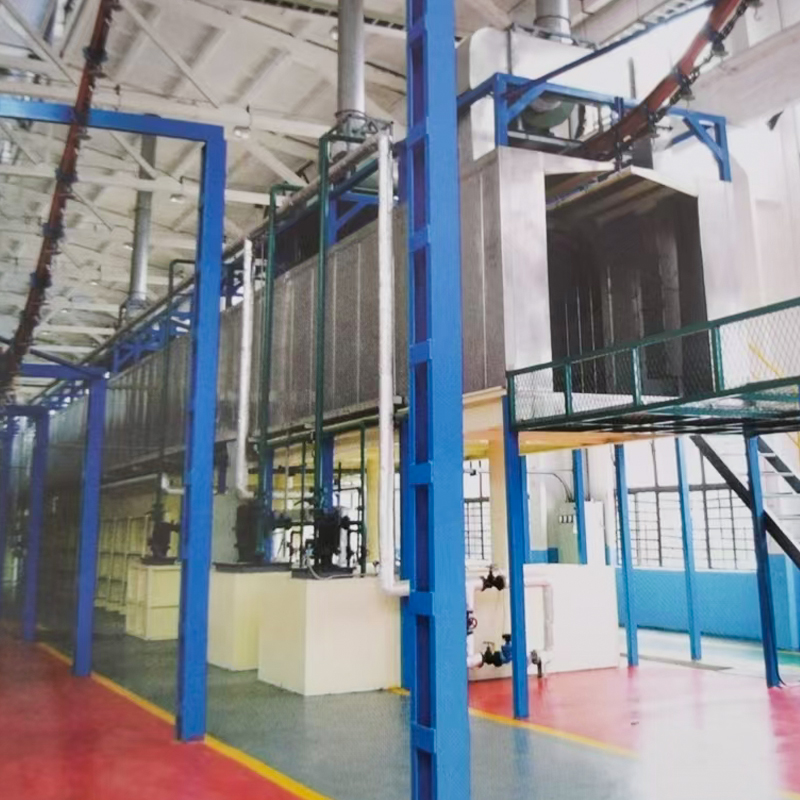
While the exact process sequence varies by industry, substrate material, and coating system requirements, a standard automotive or appliance pre-treatment line follows a well-established sequence of process stages. The following table describes a typical 10-stage sequence for a zinc phosphate pre-treatment line used before cathodic electrocoat painting:
| Stage | Process | Method | Typical Temperature | Typical Dwell Time | Purpose |
|---|---|---|---|---|---|
| 1 | Pre-degreasing | Dip + spray | 50–60°C | 3–5 min | Remove bulk oils, stamping lubricants, and wax |
| 2 | Main degreasing | Dip + submerged jet | 55–65°C | 4–8 min | Complete oil removal, surface activation |
| 3 | Water rinse 1 | Dip + overflow | Ambient | 1–2 min | Remove degreaser residue and drag-out |
| 4 | Water rinse 2 | Dip + spray | Ambient | 1–2 min | Final degreaser removal before conditioning |
| 5 | Surface conditioning | Dip | Ambient–40°C | 1–2 min | Activate surface for uniform phosphate nucleation |
| 6 | Zinc phosphating | Dip + submerged jet | 35–55°C | 3–5 min | Form conversion coating for corrosion resistance and adhesion |
| 7 | Water rinse 3 | Dip + overflow | Ambient | 1–2 min | Remove phosphate drag-out and sludge |
| 8 | Passivation / sealing | Dip + spray | 20–40°C | 1–2 min | Seal phosphate pores; enhance corrosion resistance |
| 9 | Deionized water rinse | Dip + spray | Ambient | 1–2 min | Remove ionic contamination; conductivity <20 µS/cm |
| 10 | Final DI water spray rinse | Spray only | Ambient | 30–60 sec | Final surface purification before electrocoat |
Each stage in this sequence depends on the effective completion of the previous one. Incomplete degreasing in Stage 1 and 2 contaminates all subsequent baths and prevents adequate phosphate crystal formation in Stage 6 — the most critical stage for corrosion resistance. The combined dip-spray action in the degreasing and phosphating stages is specifically designed to ensure that even the most recessed interior cavities of an automotive body receive complete treatment at each stage.
The performance advantages of dip-spray combined pre-treatment over pure dip or pure spray systems are well-documented across the automotive, appliance, and industrial coating industries. The following comparison illustrates the key differentiators:
| Performance Criterion | Pure Dip System | Pure Spray System | Dip-Spray Combined |
|---|---|---|---|
| Coverage of blind holes and cavities | Good — full immersion reaches all areas | Poor — spray cannot penetrate enclosed areas | Excellent — immersion guarantees coverage, jets flush recesses |
| Boundary layer renewal at metal surface | Poor — static depletion layer forms | Excellent — continuous fresh solution delivery | Excellent — jets continuously renew solution |
| Mechanical contamination removal | Moderate — chemical action only | Good — impact force assists loosening | Excellent — impact force combined with chemical dwell |
| Phosphate coating uniformity | Moderate — prone to heavy spots and bare areas | Limited — no coverage in spray shadows | Excellent — fine, uniform crystal structure |
| Suitability for complex part geometry | Good | Poor | Excellent |
| Water and chemical consumption | Moderate | High (continuous fresh spray) | Moderate — recirculation reduces waste |
| Capital cost | Low–Moderate | Moderate | High — justified by performance premium |
| Corrosion resistance of treated parts | Good on open surfaces | Poor on recessed areas | Excellent — full-coverage conversion coating |
In automotive applications, the corrosion resistance improvement from dip-spray combined pre-treatment is measurable and significant. Automotive bodies treated on a combined dip-spray phosphate line consistently achieve salt spray test results exceeding 1,000 hours with no creep from scribe — a standard that pure spray or pure dip lines processing the same body geometry typically fail to reach in internal cavity areas, where corrosion initiation is most likely in real-world service.
Dip-spray combined pre-treatment equipment is deployed wherever part complexity, corrosion resistance requirements, or coating adhesion standards demand the highest level of surface preparation. The following industries represent the primary application domains:
The automotive body-in-white (BIW) is the defining application for dip-spray combined pre-treatment. Modern automotive bodies are assembled from dozens of stamped steel and aluminum panels with multiple enclosed cavities, sills, pillars, and hem flanges that trap moisture in service. Every major automotive assembly plant in the world uses a dip-spray combined pre-treatment line as the foundation of its corrosion protection strategy — typically a 10 to 15-stage zinc or zinc-manganese phosphate process before cathodic electrocoat (e-coat) primer application. Tank capacities in automotive lines are large — typically 80,000 to 200,000 liters per process tank — to accommodate full vehicle body immersion.
Washing machine drums, refrigerator cabinets, oven cavities, and air conditioner housings are all examples of large, complex sheet metal assemblies with enclosed areas that require uniform pre-treatment before powder coating or wet paint application. Dip-spray combined lines in appliance manufacturing typically process parts on overhead conveyor systems at line speeds of 2 to 4 meters per minute, using iron phosphate or zinc phosphate conversion coatings depending on the corrosion resistance specification of the finished product.
Tractor chassis, combine harvester headers, excavator boom arms, and loader buckets operate in extremely corrosive outdoor environments where coating adhesion and corrosion resistance directly affect product durability and customer satisfaction. The heavy-gauge steel and complex welded assemblies typical of agricultural and construction equipment benefit greatly from the thorough cleaning and conversion coating uniformity that dip-spray combined pre-treatment delivers.
Sheet metal electrical enclosures, switchgear cabinets, and distribution boards must meet stringent corrosion resistance standards (typically ISO 12944 C3 or C4 category) while being fabricated from thin sheet steel with numerous bends, flanges, and enclosed hem joints. Dip-spray combined pre-treatment ensures that these thin-gauge, complex parts receive complete and uniform conversion coating even in their most recessed areas.
The chemical processes hosted in a dip-spray combined pre-treatment line are chosen based on the substrate material, the subsequent coating system, and the required corrosion resistance specification. The most important chemical processes are:
Alkaline degreasing baths contain a combination of sodium hydroxide or sodium carbonate (for alkalinity), surfactants (for oil emulsification), and builders (for water softening and soil suspension). Bath temperatures of 50°C to 65°C accelerate the saponification of vegetable and animal oils and the emulsification of mineral oils. The combined dip-spray action in the degreasing stage is particularly important — the spray jets mechanically dislodge particulate soils and break the oil-water interface, while full immersion ensures that all surfaces — including areas that collect pooled oil — are continuously exposed to fresh degreasing solution.
Zinc phosphate is the most widely specified conversion coating for metal pre-treatment before high-performance paint systems. The process involves the reaction of zinc, manganese, and nickel phosphate salts in a dilute phosphoric acid solution with the iron in the steel surface, forming a dense, adherent microcrystalline zinc phosphate layer with a coating weight of 1.5 to 3.5 g/m² for automotive applications. This layer provides a physical anchor for paint adhesion, acts as a barrier to moisture and oxygen, and is sacrificial — corroding preferentially to the underlying steel if the paint film is breached.
The combined dip-spray action in the phosphating stage produces significantly finer and more uniform crystal structures than static immersion — fine crystals provide more surface area for paint adhesion and a more effective barrier against under-film corrosion. Studies comparing crystal size between static dip and combined dip-spray phosphating have found crystal grain sizes of 5 to 10 µm in combined systems versus 15 to 25 µm in static dip systems — a meaningful difference in the adhesion and barrier properties of the resulting coating.
As environmental regulations restrict the use of heavy metals (nickel, manganese) in phosphating baths, zirconium-based thin-film conversion coatings are increasingly adopted as alternatives. These processes deposit an amorphous zirconium oxide layer of approximately 20 to 80 nm thickness on the metal surface — far thinner than zinc phosphate but providing comparable adhesion performance for modern waterborne and powder coating systems at significantly lower chemical cost, lower sludge generation, and reduced wastewater treatment burden. Dip-spray combined equipment is well-suited to zirconium thin-film processes, where the very short reaction times (30 to 90 seconds) require precise control of solution renewal at the part surface.
Pre-treatment processes generate wastewater containing oils, metals, phosphates, and chemical treatment residues that require treatment before discharge. Modern dip-spray combined systems incorporate several design features that minimize wastewater generation and simplify treatment, aligning with increasingly stringent environmental regulations in most industrial countries.
The quality of pre-treatment directly determines the quality of every coating applied on top of it — failures in pre-treatment are invisible until they manifest as paint delamination or corrosion in service, often years after the part has left the production line. Rigorous process control and quality assurance are therefore inseparable from the effective operation of a dip-spray combined pre-treatment system.
Modern combined pre-treatment lines are equipped with continuous in-line sensors and automated dosing systems that maintain each process bath within tight specification limits without manual intervention. Key monitored parameters include:
The following tests are routinely used to verify the quality of pre-treatment on finished parts:
For manufacturers evaluating investment in a dip-spray combined pre-treatment system, several key parameters drive the specification and selection process. Understanding these parameters helps ensure that the system delivered matches both current production requirements and anticipated future needs.
Dip-spray combined pre-treatment equipment represents one of the most critical capital investments in any coating line, directly determining the long-term corrosion resistance, adhesion performance, and warranty cost exposure of every coated product it processes. Proper specification, commissioning, and ongoing process management of this equipment are foundational to competitive quality in industries where coating performance is a key product differentiator.
2026-07-17
Industry News
2026-07-10
Industry News
2026-07-03
Industry News
2026-06-26
Industry News
2026-06-19
Industry News
2026-06-12
Industry News
For exclusive deals and latest offers, sign up by entering your email address below