English
 中文简体
中文简体

 2026-07-10
 Industry News
Content
The purpose of Pre-treatment Equipment is to chemically and mechanically prepare a metal surface so that a subsequently applied coating -- powder coating, liquid paint, or e-coat -- bonds securely and delivers long-term corrosion protection. This is achieved by removing surface contamination, creating a chemically receptive conversion coating layer, and ensuring the part is completely clean and dry before it enters the coating application booth. Without effective pre-treatment, even a high-quality coating applied with precise equipment will fail prematurely through adhesion loss, blistering, or localized corrosion breaking through from beneath the coating film.
Independent industry data consistently demonstrates the scale of this effect: according to testing referenced in NACE International (the worldwide corrosion authority) technical literature on coating performance, properly phosphated and pre-treated steel substrates can show corrosion resistance improvements of several multiples in standardized salt spray testing compared to the same coating applied directly to cleaned but otherwise untreated metal. Pre-treatment is therefore not a supplementary or optional process step -- it is the foundation on which the entire coating system's performance depends.
The most immediate and fundamental purpose of pre-treatment equipment is removing the oils, cutting fluids, drawing compounds, handling residue, dust, and oxidation that accumulate on metal parts during manufacturing, storage, and transport -- all of which physically prevent a coating from making direct molecular contact with the substrate surface.
Coating adhesion depends on intimate, continuous contact between the coating film and the substrate surface at a near-molecular scale. A contamination layer measured in micrometers -- often invisible to casual visual inspection -- is sufficient to create a weak boundary layer that prevents the coating from achieving its designed adhesion strength. This is why pre-treatment lines incorporate dedicated degreasing equipment using heated alkaline chemistry specifically formulated to saponify oils and emulsify particulate contamination, rather than relying on simple water washing, which cannot effectively remove oil-based residues.
When contamination removal is inadequate, the most common failure mode observed in finished coated products is localized adhesion loss, often visible as small areas where the coating can be peeled or flaked away relatively easily, frequently concentrated around handling points, weld seams, or recessed areas where contamination is more likely to accumulate and less likely to be fully removed by an underperforming cleaning stage. A simple water break test -- observing whether water sheets evenly across a cleaned surface or beads up in isolated droplets -- remains one of the most practical and widely used field verification methods for confirming adequate degreasing performance before a part proceeds further into the pre-treatment sequence.
Beyond simple cleaning, pre-treatment equipment performs a chemical transformation of the metal surface itself, converting the outermost layer into a different chemical structure -- typically a phosphate crystal layer -- that is fundamentally more receptive to coating adhesion than the bare or cleaned metal surface alone.
Zinc phosphate and iron phosphate conversion coatings form a microscopically rough, crystalline surface texture across the treated metal, dramatically increasing the effective surface area available for coating adhesion compared to a smooth, bare metal surface. This increased surface area, combined with the mechanical interlocking that occurs as the liquid or powder coating flows into the microscopic crystal structure before curing, creates a substantially stronger physical bond than would be achievable on an untreated, smooth metal surface alone. Industry reference data for properly formed zinc phosphate coatings typically targets a coating weight of 1.0 to 4.5 grams per square meter, a parameter directly correlated with both the corrosion resistance and the adhesion performance the conversion layer provides.
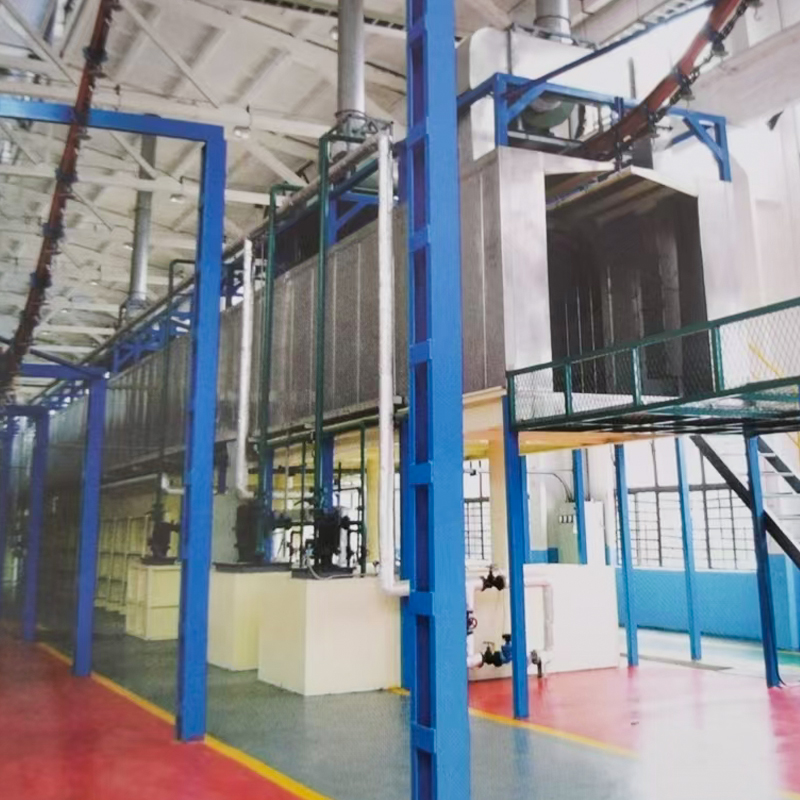
In addition to improving coating adhesion, the conversion coating layer itself provides a meaningful degree of corrosion resistance independent of any subsequently applied paint or powder coating. This becomes particularly important at locations where the topcoat may eventually be damaged, scratched, or chipped during the product's service life -- the underlying conversion coating continues to provide a degree of corrosion protection at these exposed points, slowing the progression of corrosion that would otherwise spread rapidly from a bare metal exposure point beneath an intact coating film.
One of the most economically significant purposes of pre-treatment equipment is preventing the specific failure mode known as underfilm corrosion -- corrosion that initiates and spreads beneath an intact-looking coating surface, often going undetected until the coating eventually blisters, bubbles, or delaminates as the corrosion product accumulates beneath it.
When a coating is applied over a surface with residual contamination, inadequate conversion coating coverage, or trapped moisture, microscopic gaps and weak points exist beneath the coating film from the moment of application. Moisture and oxygen can migrate through the coating film itself -- all organic coatings have some degree of permeability to water vapor and oxygen, even when intact -- and these microscopic gaps and weak points provide the initiation sites where corrosion begins. Once corrosion starts beneath a coating, the corrosion products themselves generate volume expansion that physically lifts and separates the coating from the substrate, accelerating the spread of the failure outward from the initial defect site.
ASTM B117 (Standard Practice for Operating Salt Spray Apparatus) is the most widely referenced standardized test method for evaluating coating corrosion resistance, exposing coated test panels to a continuous salt fog environment and measuring the time until visible corrosion, blistering, or coating failure occurs at a scribed test line. Properly pre-treated and coated panels routinely achieve several hundred to over a thousand hours of salt spray exposure without significant corrosion creep from the scribe line, compared to dramatically reduced performance -- often failing within a small fraction of that time -- when the same coating system is applied without adequate pre-treatment. This standardized testing data is one of the clearest, most quantifiable demonstrations of why pre-treatment equipment exists as a distinct and essential process stage rather than an optional enhancement.
Beyond functional corrosion protection and adhesion, pre-treatment equipment also serves the purpose of ensuring the finished coating achieves a consistent, uniform visual appearance across the entire part surface, which is particularly important for products where appearance quality is a direct factor in customer perception and product value.
Variations in surface cleanliness or conversion coating coverage across different areas of a part cause corresponding variations in how the topcoat flows, levels, and cures during application, often visible as gloss variation, color inconsistency, or surface texture differences between adequately and inadequately pre-treated areas of the same part. This is particularly noticeable in powder coating applications, where the electrostatic charge used to apply the powder can behave inconsistently across surface areas with variable conductivity caused by uneven conversion coating coverage, leading to visible thickness variation and orange-peel texture differences across the finished part.
The surface conditioning stage, which promotes fine, uniform phosphate crystal formation during the subsequent conversion coating step, directly serves this appearance consistency purpose by ensuring the conversion coating layer itself -- and therefore the surface the topcoat is applied onto -- is uniform across the full part surface rather than varying based on localized differences in the underlying metal's surface condition or microstructure.
From a manufacturing business perspective, one of the most significant practical purposes of investing in effective pre-treatment equipment is the reduction of warranty claims, field failures, and the associated reputational and financial costs that result from premature coating failure in the field.
The cost of operating a properly designed pre-treatment line -- chemistry consumption, energy for heating process tanks and the drying oven, water and wastewater treatment, and equipment maintenance -- is consistently and substantially lower than the cost of warranty replacement, field service visits, and reputational damage associated with coating failures that occur after products have been shipped to customers and placed into service. A field failure requiring product replacement or rework typically involves logistics, labor, and customer relationship costs that are an order of magnitude higher than the incremental cost of adequate pre-treatment during original manufacturing, making pre-treatment equipment one of the more clearly cost-justified investments within a typical coating line.
Automotive components, agricultural and construction equipment, outdoor furniture, architectural metalwork, and any product regularly exposed to weather, road salt, or industrial atmospheric contaminants place particularly high importance on this corrosion-prevention purpose of pre-treatment equipment, since these applications combine high consequence of failure (safety, structural integrity, or significant replacement cost) with challenging long-term exposure environments that will reliably expose any weakness in an inadequately pre-treated coating system over the product's service life.
The table below summarizes the practical performance differences typically observed between coated products that have received adequate pre-treatment processing and those that have not, illustrating the multiple distinct purposes pre-treatment equipment serves simultaneously.
| Performance Factor | With Adequate Pre-treatment | Without Adequate Pre-treatment |
|---|---|---|
| Coating adhesion strength | Strong, consistent mechanical and chemical bond across the surface | Weak, inconsistent bond with risk of localized peeling or flaking |
| Salt spray corrosion resistance (per ASTM B117) | Several hundred to over 1,000 hours before significant scribe creep | Often a small fraction of treated performance; early scribe creep and blistering |
| Underfilm corrosion risk | Significantly reduced due to conversion coating barrier and improved adhesion | Elevated, with corrosion initiation at contamination or coverage gaps |
| Visual appearance consistency | Uniform gloss, color, and texture across the part surface | Visible gloss, color, or texture variation tied to surface inconsistency |
| Expected field service life | Meets or exceeds product design life expectations | Premature failure, often well before design life is reached |
| Warranty and field failure cost exposure | Low, consistent with budgeted product quality expectations | Elevated, with unpredictable timing and scale of failure-related costs |
While effective pre-treatment benefits virtually any coated metal product, certain industries place particularly high demands on pre-treatment performance due to the severity of their operating environment or the consequences of coating failure.
Confirming that pre-treatment equipment is genuinely fulfilling its intended purpose requires monitoring specific, measurable indicators rather than relying solely on the visual appearance of the finished coated product, since many pre-treatment-related failures only become apparent after extended field service.
Pre-treatment is necessary for virtually all coating applications intended to provide meaningful, long-term corrosion protection and durable adhesion, regardless of whether the topcoat is powder coating, liquid paint, or another coating technology. The specific intensity and number of pre-treatment stages required can vary based on the application's performance requirements, with lower-specification, short-service-life, or indoor-only applications sometimes using a reduced pre-treatment sequence, but completely omitting pre-treatment is rarely appropriate for any application where coating durability matters to the end use of the product.
While the specific chemistry differs substantially, the underlying purpose of pre-treatment -- removing surface contamination and creating a chemically receptive surface for coating adhesion -- applies conceptually to plastic and composite substrates as well, though these materials typically use different surface preparation methods such as flame treatment, plasma treatment, or specialized adhesion-promoting primers rather than the phosphate conversion coating chemistry used for ferrous and aluminum metal substrates discussed throughout this article.
The fundamental purposes of contamination removal and adhesion improvement apply equally to both indoor and outdoor applications, but the corrosion-resistance purpose becomes proportionally more critical for outdoor applications exposed to moisture, temperature cycling, and atmospheric contaminants, often justifying a more comprehensive pre-treatment sequence with higher conversion coating weight targets and more robust sealing rinse chemistry for outdoor-rated products compared to equivalent indoor-only applications with a less demanding long-term exposure environment.
Yes, through the verification methods discussed in the previous section, including water break testing, coating weight verification, and standardized salt spray testing, all of which can identify pre-treatment deficiencies during production or quality control review well before a product is shipped and placed into field service. Relying solely on visual inspection of the finished coated appearance is generally insufficient, since many pre-treatment-related defects are not visually apparent until the coating has been exposed to corrosive conditions over an extended period in actual field use.
2026-07-10
Industry News
2026-07-03
Industry News
2026-06-26
Industry News
2026-06-19
Industry News
2026-06-12
Industry News
2026-06-05
Industry News
For exclusive deals and latest offers, sign up by entering your email address below