English
 中文简体
中文简体

 2026-07-10
 Industry News
Content
Pre-treatment Equipment typically includes a sequence of six core process stages: degreasing, water rinsing, surface conditioning, phosphating or conversion coating, a further rinse sequence, and a final passivation or sealing rinse, followed by a drying stage before the workpiece moves into the coating booth. Each stage is performed in a dedicated process tank or spray chamber, and the workpiece -- whether suspended on an overhead conveyor or carried through on a roller or chain system -- passes through each stage in a fixed sequence to achieve a clean, chemically receptive surface that maximizes the adhesion and corrosion resistance of the coating applied afterward.
The exact configuration and number of stages varies based on the substrate material, the level of corrosion protection required, and the specific coating technology used downstream -- powder coating, liquid painting, or e-coating each have somewhat different pre-treatment requirements. The sections below detail each process stage individually, along with the equipment design considerations and quality control parameters that determine how effectively the pre-treatment line performs its function.
Degreasing is the first and arguably most critical stage in any pre-treatment sequence, since residual oils, cutting fluids, drawing compounds, and handling contamination on the workpiece surface will prevent proper contact between the metal substrate and the subsequent conversion coating chemistry if not fully removed.
Most industrial pre-treatment lines use alkaline degreasing solutions, typically formulated with sodium hydroxide, sodium carbonate, surfactants, and sequestering agents, operated at a working pH of approximately 10 to 12 and a temperature range of 50 C to 65 C. The combination of chemical action (saponification of oils and surfactant emulsification) and mechanical action (spray impingement or immersion agitation) breaks down and lifts contamination from the workpiece surface. According to general industry guidance published by the American Coatings Association on metal pretreatment processes, degreasing stage dwell time in a well-designed line typically ranges from 60 to 180 seconds depending on the contamination level and part geometry, with spray application generally achieving faster cleaning than immersion alone due to the additional mechanical scrubbing effect of the spray impingement.
Degreasing stations are typically configured as either spray tunnels, where heated cleaning solution is pumped through a series of nozzles arranged around the conveyor path, or immersion tanks, where parts are fully submerged with mechanical or air agitation to improve contact between the cleaning solution and all surfaces of the part, including recesses and internal cavities that spray alone may not reach effectively. Many production lines use a combination approach -- spray pre-cleaning followed by immersion for complex geometries -- to achieve thorough contamination removal across varied part shapes within a single production run.
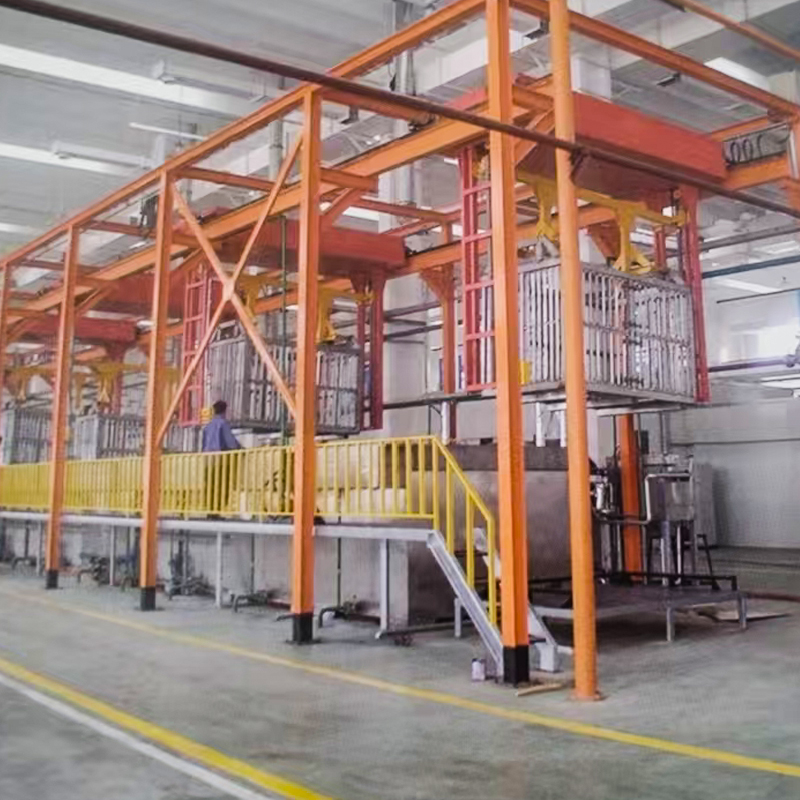
After degreasing, the workpiece carries a film of spent cleaning solution and the contaminants it has lifted from the surface, which must be removed before the part proceeds to the next chemical process stage to prevent cross-contamination between process baths.
A single rinse stage using fresh or recirculated water reduces the concentration of carried-over degreasing chemistry on the part surface, but multi-stage rinsing -- typically two sequential rinse tanks operated in a countercurrent flow arrangement -- achieves substantially lower residual contamination levels for the same water consumption, since the first rinse tank removes the bulk of the carryover while the second tank, supplied with cleaner water, achieves the final reduction to an acceptably low residual level. Countercurrent rinse configurations are widely used in industrial pre-treatment lines specifically because they reduce total fresh water consumption while maintaining rinse water quality, an important consideration given that water and wastewater treatment costs represent a meaningful portion of ongoing pre-treatment line operating expense.
Conductivity monitoring of rinse water is a standard quality control method used to confirm that carryover contamination remains within acceptable limits before the part proceeds to the next process stage. Excessive conductivity in the rinse water, indicating high dissolved solids from degreasing chemical carryover, signals that the rinse stage requires more frequent water replacement or that drag-out from the preceding tank needs to be reduced through improved part drainage design or dwell time adjustment.
Surface conditioning, sometimes called activation or grain refinement, prepares the cleaned metal surface to receive a finer, more uniform conversion coating crystal structure during the subsequent phosphating stage.
Without a conditioning step, phosphate conversion coatings tend to form larger, more irregular crystal structures on the metal surface. Surface conditioning chemistry, typically based on titanium phosphate colloidal particles, deposits microscopic nucleation sites across the metal surface that promote the formation of a finer, denser, and more uniform phosphate crystal layer in the following stage. This finer crystal structure directly improves both the corrosion resistance and the paint adhesion performance of the finished coated product, since a denser, more uniform phosphate layer provides more consistent anchoring for the subsequent paint or powder coating film.
Surface conditioning solutions are generally used at ambient or slightly elevated temperature, with relatively short dwell times typically in the range of 30 to 60 seconds, since the conditioning effect relies on surface adsorption of conditioning particles rather than a bulk chemical reaction requiring extended contact time. Conditioning bath concentration and pH must be maintained within the supplier's specified operating range, as conditioning baths that become depleted or contaminated lose their effectiveness at promoting fine-grain phosphate crystal formation in the next stage.
The phosphating or conversion coating stage is the core chemical treatment step in most pre-treatment lines, forming a thin, adherent crystalline or amorphous layer on the metal surface that provides corrosion resistance in its own right and dramatically improves the adhesion of subsequently applied paint or powder coating.
Zinc phosphate and iron phosphate are the two most widely used conversion coating chemistries in industrial pre-treatment lines for steel substrates. Zinc phosphate coatings generally provide superior corrosion resistance and paint adhesion compared to iron phosphate, making them the preferred choice for products requiring higher corrosion performance specifications, such as automotive components and outdoor equipment, while iron phosphate coatings offer a lower-cost option suitable for less demanding corrosion environments. For aluminum and mixed-metal substrates, specialized conversion coating chemistries -- including chromium-free conversion coatings increasingly adopted in response to environmental regulations restricting hexavalent chromium use -- are formulated to achieve comparable performance on these different substrate materials.
Conversion coating performance is commonly quantified by coating weight, measured in milligrams per square meter of treated surface. Industry reference data for zinc phosphate coatings on steel typically targets a coating weight in the range of 1.0 to 4.5 grams per square meter, with the specific target depending on the corrosion performance requirement and the type of topcoat to be applied. Coating weight is verified through periodic destructive testing -- stripping the conversion coating from a sample area and measuring the weight difference -- as part of routine quality control on production lines processing critical corrosion-resistance applications.
Spray phosphating generally produces a finer, more uniform crystal structure than immersion phosphating due to the continuous mechanical renewal of solution at the part surface during spray application, while immersion phosphating offers more complete coverage of complex part geometries including internal cavities and recessed areas that spray nozzles cannot directly reach. Many production lines handling parts with both flat external surfaces and complex internal geometry use immersion phosphating specifically to ensure complete coverage, accepting the somewhat coarser crystal structure as an acceptable tradeoff for complete coating coverage.
Following the phosphating stage, the workpiece again requires rinsing to remove residual phosphating chemistry and any loose, non-adherent crystal deposits from the surface before proceeding to the final treatment stage.
The phosphating reaction produces a byproduct sludge of iron phosphate or zinc phosphate particles that do not adhere to the part surface and must be rinsed away to prevent these loose particles from being trapped beneath the subsequently applied coating, where they would create surface defects and localized adhesion failures in the finished product. As with the degreasing rinse stage discussed earlier, multi-stage countercurrent rinsing is the standard equipment configuration for this step, balancing thorough contaminant removal against water consumption.
Parts with deep recesses, overlapping panels, or box sections present particular challenges for thorough post-phosphate rinsing, since residual phosphating solution and sludge trapped in these areas can continue to react or cause localized corrosion issues if not adequately flushed out. Pre-treatment line designers address this through nozzle placement optimized for problem geometries, extended dwell time in immersion rinse tanks, and in some cases dedicated high-pressure spray jets directed at known problem areas identified during line commissioning and process validation.
The final stage in most pre-treatment sequences applies a sealing or passivation rinse that further enhances the corrosion resistance of the conversion coating and prepares the surface for the drying stage that follows.
Historically, dilute chromic acid solutions were widely used as a final sealing rinse due to their excellent corrosion inhibition performance, sealing residual porosity in the phosphate layer and providing supplementary corrosion protection. Due to environmental and worker safety regulations restricting hexavalent chromium use in many regions -- including the EU RoHS Directive and REACH Regulation -- chrome-free sealing rinse chemistries based on zirconium, silane, or other proprietary organic and inorganic formulations have become the standard choice in modern pre-treatment lines, achieving comparable sealing performance without the regulatory and environmental concerns associated with hexavalent chromium.
Many pre-treatment sequences incorporate a final rinse using deionized (DI) water rather than standard tap or process water, since dissolved mineral ions present in normal water supplies can interfere with optimal coating adhesion and contribute to early corrosion initiation points if left on the surface during drying. DI water final rinse stages are typically operated with conductivity monitoring to confirm the rinse water itself remains within an acceptable purity range, commonly targeting conductivity below 50 microsiemens per centimeter for critical corrosion-resistance applications.
After the final rinse stage, the workpiece must be fully dried before entering the powder coating booth or paint application area, since residual moisture trapped beneath a subsequently applied coating film can cause blistering, poor adhesion, and corrosion initiation beneath the finished coating.
Drying ovens are typically configured as convection ovens using heated, circulated air, with operating temperatures commonly in the range of 100 C to 150 C and dwell times calibrated to the part mass, geometry, and conveyor line speed to ensure complete moisture evaporation, including from recessed areas and box sections where moisture can be trapped longer than on open flat surfaces. Drying oven temperature must also remain below the threshold that would cause unwanted thermal effects on the substrate material or the conversion coating layer itself, requiring careful process parameter coordination between the pre-treatment chemistry supplier and the oven equipment design.
Production quality control typically includes periodic visual and, where critical, instrumented verification that parts exiting the drying stage are fully dry, particularly for complex geometries with water-trapping features. Some advanced pre-treatment lines incorporate infrared moisture sensors at the drying oven exit to provide continuous, non-destructive confirmation of adequate drying before parts proceed to the coating application stage, reducing the risk of moisture-related coating defects reaching the final inspection stage where rework costs are considerably higher.
The table below consolidates the typical process stages, operating parameters, and primary purpose of each step in a standard industrial pre-treatment line, providing a quick reference for comparing against a specific line configuration or specification.
| Stage | Typical Temperature | Typical Dwell Time | Primary Purpose |
|---|---|---|---|
| Degreasing | 50 C to 65 C | 60 to 180 seconds | Remove oils, cutting fluids, and surface contamination |
| Water rinse (post-degreasing) | Ambient | 30 to 60 seconds | Remove residual degreasing chemistry and lifted contaminants |
| Surface conditioning | Ambient to slightly elevated | 30 to 60 seconds | Promote fine, uniform phosphate crystal formation |
| Phosphating / conversion coating | 35 C to 60 C (chemistry-dependent) | 60 to 180 seconds | Form corrosion-resistant, paint-adherent conversion layer |
| Water rinse (post-phosphating) | Ambient | 30 to 60 seconds | Remove sludge and loose, non-adherent crystal deposits |
| Sealing / passivation rinse | Ambient | 20 to 45 seconds | Seal coating porosity, enhance corrosion resistance |
| Drying | 100 C to 150 C | 5 to 15 minutes (geometry-dependent) | Remove residual moisture before coating application |
Beyond the chemical process sequence itself, the physical equipment configuration used to deliver each stage significantly affects throughput, coverage quality, and operating cost. Understanding these configuration options helps buyers specify the right Pre-treatment Equipment for their specific part geometry and production volume requirements.
Maintaining consistent pre-treatment quality across a production run requires monitoring specific parameters at each stage rather than relying solely on visual inspection of the finished coated product, since pre-treatment defects often only become visible after the coating has been applied and the part has been in service for some time.
Skipping or shortening a stage is technically possible but typically compromises the corrosion resistance and coating adhesion performance of the finished product to a degree proportional to the importance of the skipped step. Surface conditioning is sometimes omitted in lower-specification applications where the coarser phosphate crystal structure that results is acceptable for the corrosion performance requirement, but degreasing, phosphating, and adequate rinsing are generally considered essential stages for any application requiring reliable, durable coating performance.
Total dwell time across all stages, including drying, commonly ranges from 15 to 30 minutes for a standard seven-stage line processing typical steel fabrications, though this varies considerably based on part size, geometry complexity, conveyor speed, and the specific number and length of stages included in a given line design. Lines processing smaller, simpler parts at high volume may achieve shorter total cycle times through faster conveyor speeds and optimized stage lengths.
The core pre-treatment chemistry and stage sequence is broadly similar for both powder coating and liquid paint applications, since both rely on the same fundamental need for a clean, chemically receptive, corrosion-resistant surface. The primary difference typically lies in the drying stage requirements and the specific conversion coating weight target, since powder coating applications, which involve an electrostatic charge during application, can be particularly sensitive to surface conductivity variations that an inadequately or unevenly applied conversion coating could introduce.
Full bath replacement frequency depends heavily on production volume, the contamination load introduced by incoming parts, and the specific chemistry supplier's recommended maintenance schedule, but most industrial lines operate on a partial bottoming-up and dosing maintenance approach -- continuously or periodically adding fresh chemistry to maintain target concentration -- rather than complete periodic bath replacement, with full bath drain and refill typically reserved for situations where contaminant buildup (such as accumulated iron from degreasing or sludge from phosphating) exceeds levels that dosing maintenance alone can adequately control.
2026-07-10
Industry News
2026-07-03
Industry News
2026-06-26
Industry News
2026-06-19
Industry News
2026-06-12
Industry News
2026-06-05
Industry News
For exclusive deals and latest offers, sign up by entering your email address below