NEWS

Home / News / Industry News / What is a dry type spray booth?

What is a dry type spray booth?

A dry type spray booth is a controlled painting enclosure that captures paint overspray using dry filter media — such as paper, cardboard baffle filters, or fiberglass panels — instead of water. When paint is sprayed onto a workpiece inside the booth, the airflow system draws the overspray-laden air through the dry filter layers, which trap the paint particles while allowing clean air to pass through and exhaust to the outside. The system requires no water supply, no chemicals for water treatment, and produces no liquid sludge — making it operationally simpler and significantly cheaper to run than traditional water-wash spray booths for many industrial painting applications.

How a Dry Type Spray Booth Works

The operating principle involves a controlled unidirectional airflow that carries overspray from the spray zone through successive filtration stages:

  1. Makeup air supply: filtered supply air enters the booth from above (downdraft design) or from one end (cross-draft design), creating a consistent airflow that carries overspray particles away from the painter and the workpiece
  2. Overspray capture at primary filters: the first stage of filtration — typically cardboard baffle filters or progressive density fiberglass panels — captures the largest paint droplets and protects the secondary filtration stages from loading too quickly
  3. Secondary fine filtration: a second-stage filter (often a synthetic fiber or paper filter) captures the finer paint mist particles that pass through the primary layer, achieving the final paint capture efficiency required for compliance with VOC emission regulations
  4. Clean air exhaust: the filtered air exits through the exhaust fan and ductwork — in regions with strict emissions requirements, a final activated carbon or catalytic oxidizer stage may be added to capture residual solvent vapors

The primary maintenance task is monitoring filter saturation and replacing or disposing of the filter media when the pressure differential across the filter bank indicates it is loaded to capacity — typically tracked by a magnehelic gauge on the booth control panel.
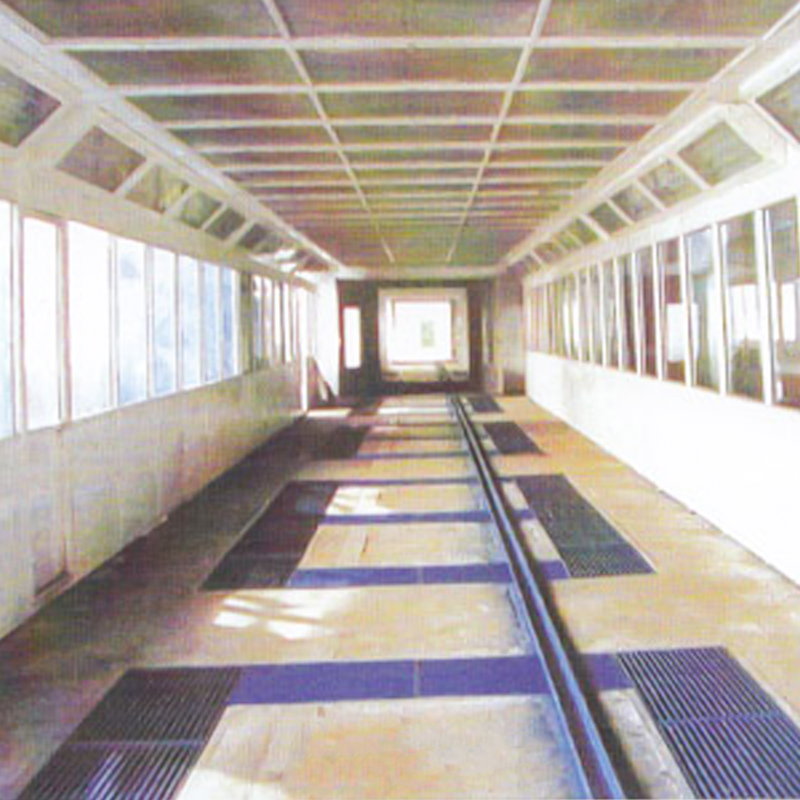
Dry Type Spray Booth

Dry Type vs. Water-Wash Spray Booth

Criterion Dry Type Booth Water-Wash Booth
Overspray capture method Dry filter media Water curtain and chemical treatment
Water requirement None Continuous water supply and treatment
Waste stream Solid filter media (disposal) Paint sludge (hazardous waste handling)
Operating complexity Low High (water chemistry management)
Installation cost Lower Higher (water supply, drain, treatment)
Running cost Lower (filter replacement only) Higher (water, chemicals, sludge disposal)
High-volume production Filters load faster — higher filter cost Better suited
Direct comparison of dry type and water-wash spray booth systems across key operational criteria

Filter Media Types Used in Dry Spray Booths

The performance of a dry type booth is largely determined by the filter media specified for the application:

  • Cardboard baffle filters (Euroflex / labyrinth type): low-cost primary filters that capture paint by forcing airflow through a series of angular paper baffles; typically rated for 95–98% efficiency on droplets above 10 microns; disposable and widely available
  • Fiberglass primary filters: higher efficiency than cardboard at comparable price; better suited to waterborne coatings where cardboard can sag when moisture-laden
  • Synthetic fiber secondary (exhaust) filters: high-efficiency filters capturing paint particles down to 1–3 microns for emission compliance; rated at 99.9% efficiency on sub-5 micron particles in quality installations
  • Activated carbon or catalytic oxidizer (optional tertiary): added for VOC solvent capture when local emission regulations require treatment of the exhaust air stream beyond particulate filtration

Industries and Applications Where Dry Type Booths Are Used

Dry type spray booths are well-suited to a specific range of industrial painting applications where their operational simplicity and low infrastructure requirements provide a decisive advantage:

  • Woodworking and furniture manufacturing: painting and lacquering of cabinet doors, furniture panels, and joinery — where water-wash booths would create humidity problems in wood products and wood dust combines poorly with water treatment systems
  • Small and medium-volume automotive refinishing: body shop painting of vehicles and components where the production volume does not justify the infrastructure cost of a water-wash system
  • Metal components and general industrial: primer and topcoat application on fabricated metal parts, machinery housings, and equipment — particularly suitable where a water connection to the booth location is unavailable or restricted
  • Powder coating support: dry type booths are used as manual touch-up booths alongside automated powder coating lines, where the low setup cost and easy filter replacement make them practical for low-volume manual operations
What's the news?
Keep Up To Date With Our Latest News
Read More