English
 中文简体
中文简体

 2026-07-17
 Industry News
Content
A miniature electrophoretic coating line—also called a compact e-coat line or small-scale electrophoresis production line—is a highly integrated, step-type surface coating system specifically engineered for businesses that process small-to-medium volumes of relatively small workpieces within a limited factory footprint. Unlike full-scale industrial electrocoating lines that may span hundreds of metres and require dedicated factory buildings, a miniature line consolidates pretreatment, electrophoretic deposition, rinsing, and curing into a single compact installation that can fit within a floor area of as little as 30 to 150 square metres, while still delivering the corrosion resistance, coating uniformity, and automation level that electrocoating is known for.
These systems are designed specifically for hardware manufacturers, automotive parts suppliers, bicycle and motorcycle components producers, electronic enclosures fabricators, and similar industries where cathodic or anodic electrophoretic coating is the required finish but where order volumes and part sizes do not justify the capital investment and space demands of a conventional continuous conveyor e-coat line.
Before understanding what makes a miniature line distinctive, it is useful to understand the electrophoretic coating process itself and the properties it delivers—because the value of any electrophoresis line, miniature or full-scale, is rooted in the electrochemical coating mechanism.
Electrophoretic coating (also called e-coating or electrodeposition coating) submerges a metal workpiece in a water-based paint bath containing charged resin and pigment particles. When a DC voltage is applied between the workpiece and counter-electrodes in the bath, the charged particles migrate through the solution under the electric field and deposit uniformly onto the workpiece surface. The deposited film is insoluble in water, so once a portion of the surface is coated, that area becomes electrically insulating and the coating migrates to uncoated areas instead—a self-limiting mechanism that produces exceptional coating uniformity across complex geometries, recesses, cavities, and edges that spray painting cannot reliably reach.
After deposition, the workpiece is rinsed to remove drag-out paint solution and then cured in an oven (typically at 160°C to 200°C for 20 to 30 minutes), crosslinking the resin into a hard, dense, corrosion-resistant film. The resulting coating typically has a thickness of 15 to 35 micrometres and provides salt spray corrosion resistance of 500 to 1,000 hours or more depending on the paint system and substrate preparation quality.
Two polarities of e-coating are used commercially. In cathodic electrophoresis (CED), the workpiece is the cathode (negative electrode) and positively charged resin particles deposit on it. Cathodic systems are the dominant technology for corrosion-resistant primers because the cathodic electrochemical reaction produces hydroxide ions that are not corrosive to the substrate, and cathodic coatings achieve superior corrosion resistance compared to anodic alternatives. In anodic electrophoresis (AED), the workpiece is the anode (positive electrode) and negatively charged particles deposit on it. Anodic systems are simpler and less expensive but produce coatings with lower corrosion resistance due to the oxidative dissolution of metal ions at the anode surface. Miniature e-coat lines are available in both configurations, with cathodic systems increasingly dominant in new installations due to their performance advantage.
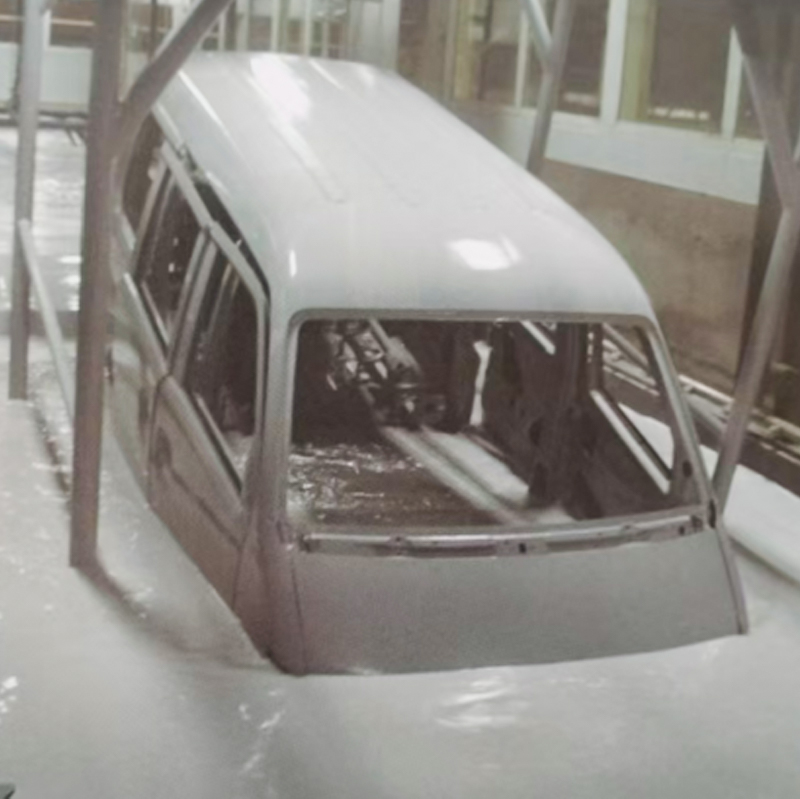
A miniature e-coat line follows the same fundamental process sequence as a full-scale industrial line, but implements it in a compact, step-type (batch or intermittent) configuration rather than as a continuous conveyor system. Workpieces are loaded onto jigs or racks, then moved sequentially through a series of treatment tanks and stations, each performing a defined step in the coating process.
Several specific design features distinguish a miniature electrophoretic coating line from both full-scale industrial lines and from simple manual tank setups used for very low-volume experimental or prototype coating.
The defining characteristic is spatial efficiency. All process tanks, rinse stations, filtration equipment, rectifiers, controls, and the curing oven are designed as an integrated system with a minimal total footprint. Typical miniature line configurations occupy 30 to 200 square metres of floor space, with tank volumes ranging from 500 litres to 5,000 litres for the e-coat bath itself. This compares to industrial lines where the e-coat tank alone may hold 50,000 to 200,000 litres. The reduced bath volume means lower initial paint inventory cost but also requires more careful bath management because the ratio of workpiece surface area to bath volume (the loading ratio) is higher, creating larger swings in paint concentration with each production batch.
Full-scale e-coat lines use continuous conveyor systems where workpieces move at a fixed speed through stationary tanks. Miniature lines use a step-type or batch configuration where loaded racks of workpieces are transferred manually or by hoist between tanks in discrete steps, dwelling at each station for the required treatment time before moving to the next. This approach eliminates the high capital cost of continuous conveyor systems, reduces line length significantly, and provides operational flexibility—the dwell time at each station can be adjusted independently to accommodate different workpiece sizes, substrate types, or coating specifications without changing conveyor speed.
Miniature lines are available across a range of automation levels to match different production volumes and labour cost structures:
Quality miniature e-coat lines include integrated bath monitoring and control systems—sensors and controllers for bath temperature, pH, conductivity, solid content, and solvent content that provide real-time process data and trigger alarms when parameters drift outside specified windows. The ultrafiltration system that manages paint recovery and waste water generation is typically included as part of the integrated package, sized to the bath volume and production throughput of the specific line.
| Parameter | Miniature E-Coat Line | Full-Scale Industrial E-Coat Line |
|---|---|---|
| Floor space required | 30–200 m² | 500–5,000+ m² |
| E-coat bath volume | 500–5,000 litres | 50,000–200,000+ litres |
| Production throughput | Low–Medium (batch mode) | High (continuous conveyor) |
| Capital investment | Significantly lower | Very high |
| Part size flexibility | High (adjustable rack dimensions) | Fixed by conveyor carrier and tank dimensions |
| Product mix flexibility | High (different programs per batch) | Low (optimised for specific part family) |
| Coating quality achievable | Equivalent (same paint systems) | Equivalent |
| Bath management complexity | Higher (small volume = larger concentration swings) | More stable (large volume buffers variations) |
| Installation time | Weeks to a few months | Months to over a year |
The miniature electrophoretic coating line occupies a specific niche in the surface treatment market—serving industries and business models where the performance of electrocoating is essential but where production scale, part sizes, or economic constraints rule out a full-scale industrial installation.
Manufacturers of door hardware, furniture fittings, fasteners, brackets, hinges, and similar small metal parts frequently use miniature e-coat lines to apply corrosion-resistant primer and decorative colour coating. Hardware items are particularly well-suited to e-coating because their complex shapes—recesses, channels, threaded holes, and inside corners—receive uniform coating coverage through the throwing power of the electrodeposition process, whereas spray painting would leave uncoated shadows in these areas. A miniature line processing racks of several hundred pieces per batch can efficiently handle the medium production volumes typical of a hardware manufacturer serving multiple product ranges.
Bicycle frames, forks, handlebar stems, brake calipers, and motorcycle frame components are commonly processed through e-coat as a primer layer before powder coating or liquid paint topcoat application. The e-coat primer provides superior corrosion protection inside the hollow frame tubes where spray paint cannot penetrate, and ensures complete coverage of welded joints where corrosion typically initiates first. Bicycle and motorcycle parts manufacturers producing thousands to tens of thousands of frames per month represent an ideal throughput scale for a miniature e-coat line.
Smaller automotive parts suppliers producing brackets, clips, housing components, and sub-assembly parts may not have the volume or space to justify a full-scale automotive e-coat line but still need to meet OEM corrosion resistance specifications—typically requiring 500 to 1,000+ hours of salt spray resistance as a minimum. A miniature cathodic e-coat line enables these suppliers to bring e-coating in-house, eliminating the lead time, logistics cost, and quality control uncertainty of outsourcing to a contract coater.
Metal enclosures for electrical switchgear, control panels, junction boxes, and electronic device housings require both corrosion protection and a cosmetically acceptable appearance. E-coating produces a smooth, uniform, pinhole-free film across complex sheet metal geometries without the runs, sags, and orange peel texture that can affect spray-applied primers. Miniature e-coat lines in this segment are often integrated with a subsequent powder coat topcoat line, providing a two-layer coating system that achieves the highest level of corrosion and UV resistance.
Surface treatment job shops that offer e-coating as a service to multiple customers benefit from a miniature line's flexibility—the ability to process different part types, sizes, and specifications in separate batches with quick programme changes between jobs. A single miniature line can serve 10 to 20 different customer accounts producing different product families, providing the economics of scale that individual small manufacturers cannot achieve independently.
Operating a miniature e-coat line successfully requires understanding and controlling the key process parameters that determine coating quality. Unlike spray painting, where an experienced operator can visually judge and adjust application in real time, electrophoretic coating is an electrochemical process where quality problems may not be apparent until after curing, when correction is impossible.
For businesses currently outsourcing e-coating to contract coaters or using alternative coating methods that do not meet corrosion resistance requirements, a miniature electrophoretic coating line offers a set of strategic and operational advantages that justify the investment analysis.
2026-07-17
Industry News
2026-07-10
Industry News
2026-07-03
Industry News
2026-06-26
Industry News
2026-06-19
Industry News
2026-06-12
Industry News
For exclusive deals and latest offers, sign up by entering your email address below